top of page
Search

Dearest Practitioner,


Every few months, the aesthetic landscape produces a new wave of panic, a headline, a rumour, a dramatic announcement crafted to shake confidence rather than give clarity. This week’s spectacle arrived wrapped in purple branding, accompanied by claims that BioRePeel was now “restricted” to HCPs only, with Level 5 therapists as the lone exception.


And just like that, confusion spread faster than a lunchtime peel.


But allow us to steady the quill and draw the line straight.


First: BioReRePeel is a brand, not a category.


It is one of many TCA-based peeling systems on the market. It is not uniquely dangerous, nor uniquely sacred. Some practitioners adore it; others find better performance elsewhere. As with all things cosmetic, choice, training, and protocol matter far more than a label on a bottle.

Second: Insurance companies do not regulate the industry.


They respond to risk data, not hype.


And according to the insurers who actually underwrite claims:


  • The highest incidence of reported complications does not come from TCA peels.

  • They come from high-strength salicylic and lactic peels, often when clients assume a burn is “just part of the peel.”

  • The frequency of insurance claims for TCA peels remains low.

  • No regulatory body has declared BioRePeel unsafe.

  • No manufacturer has announced a restriction on its use.

  • In other words, this is not about the chemistry.


It’s about the narrative.


Education, refinement, and the steady pursuit of excellence should never be shied away from. They are the quiet signatures of a practitioner who honours their profession and their future. Such growth is to be welcomed, even celebrated. Yet, Dearest Practitioner, one must also recognise the intentions that sit behind sudden, startling announcements. Not every declaration is made for the good of the many; at times, it serves the interests of a select few. And when proclamations arrive without warning or explanation, it becomes essential to discern sincere guidance from narratives shaped by influence, ambition, or quiet agendas moving beneath the surface.


Where the BioRepeel Panic Really Comes From


For years, certain groups have advocated for a model where insurance, regulation, and professional status are tightly interwoven, creating an environment in which a small circle of well-connected individuals can, in practice, shape who is perceived as “allowed” to operate within the aesthetics field.


This sentiment has surfaced repeatedly in industry discussions featuring organisations such as the JCCP and BAMAN, along with long-established insurers like Hamilton Fraser and Insync. All hold significant visibility and influence in the public conversation, which naturally shapes how practitioners interpret authority, legitimacy, and risk.


And in a country where open discussion is a protected right, it is entirely appropriate, indeed necessary, for British citizens to question, analyse, and debate any structure that has the power to steer an entire sector.


Some called for a future where only a handful of insurers were preferred, where only specific brands were “approved” and others quietly pushed out, and where the industry’s vast, diverse workforce became dependent on one route to credibility.


It reflects a familiar pattern within the sector: influence, lobbying, and market preference often travel through the same well-connected circles. When those voices dominate the conversation, it naturally shapes how the wider industry understands authority, legitimacy, and opportunity.


And when one insurer issues a dramatic announcement that others immediately refute, it raises the oldest question in British public life: Who benefits?


Additionally, those familiar with product trends will recognise that some of this pressure has coincided with a broader resistance to Korean technology, despite its global clinical success. When influence narrows, innovation, especially international innovation, can become an unintended casualty.


💗 The Pink Response: Calm, Evidence-Based, and Human

Within hours, other insurers, notably the companies in pink, responded with clarity:


“Nothing has changed.”

“BioRePeel remains insurable.”

“There is no formal industry-wide restriction.”

“If in doubt, request written confirmation directly from the distributor or manufacturer.”

This is what responsible industry communication looks like. Calm. Clear. Transparent. Not chaos.


🧠 A Reminder: Your Power Lies in Knowledge, Not in Panic

As practitioners, we have a duty to stay informed, question commerce-driven proclamations, and protect our clients from misinformation.


The truth is simple:


If you are trained, qualified, insured, and operating within manufacturer guidelines, you are compliant.

A single insurer’s stance does not rewrite the law, the regulations, or the fundamentals of safe practice.


This Moment Is Bigger Than BioRePeel


It highlights something deeper in our sector:


🪶 The importance of independent insurers


🪶 The danger of centralised control


🪶 The need for practitioners to verify information at the source


🪶 The growing pushback against fear-led narratives


🪶 And the rising expectation for accuracy, not theatrics

In many ways, this is the very scenario that the aesthetics community feared:


a market being nudged toward exclusivity, disguised as “safety”.

But thankfully, not all players subscribe to that script.


So, Dearest Practitioner, what must you do?


🪶 Stay educated.


🪶 Stay insured.


🪶 Stay questioning.


🪶 And above all, stay united.

The real threat to safety is not non-healthcare professionals (HCPs) or specific brands.


It is misinformation.


It is panic where clarity should sit.


It is the slow drip of narratives designed to create hierarchy where collaboration should thrive.

But knowledge, transparency, and community outshine all of it.


And today, we saw that light, in pink.


If any brand ever decides it no longer wishes to welcome you, take heart. The world is vast, and excellence is not confined to a single label on a bottle. There are countless formulations, numerous innovations, and abundant manufacturers who will open their arms and their supply chains to skilled, ethical practitioners. No brand holds the crown here; the industry’s strength has always come from diversity, not exclusivity.


Yours faithfully,


The Injector’s Quill


Graphic with the title “The Truth Behind the BioRePeel Panic” and tagline “When whispers travel fast, accuracy must speak louder,” relating to misinformation, insurance clarity, and professional guidance for aesthetic practitioners.


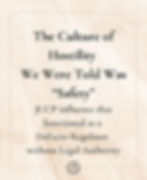
The DeFacto Culture of Hostility We Were Told Was “Safety”


Dearest Practitioner,


This is not a victory lap.


It is a reckoning, and an invitation.


If you are an aesthetic medical professional who entered the JCCP orbit believing you were protecting patients, raising standards, or doing “the right thing,” only to find yourself in the toxic cycle of opposing non-HCP practitioners, monitoring colleagues, or quietly questioning the hostility it created, this is for you.


And if you are a non-HCP aesthetics practitioner who has been monitored, trolled, reported, isolated, frozen out, or professionally bullied for existing, collaborating or refusing to bow to intimidation, this is especially for you.


Take a breath.

Something important has shifted.


The Charity Commission has issued four formal reports relating to the JCCP.


That alone matters.

More importantly, those reports were followed by:


  • Leadership restructuring

  • Changes to governance terms

  • The retirement of David Sines


This is a regulatory correction.


In Charity Commission language, this means material governance failings were identified, and corrective action was required.


Not suggested.

Required.


This is what happens when a charity:


  • Exceeds its lawful remit

  • Blurs governance boundaries

  • Concentrates influence inappropriately

  • Or presents itself as something it is not


Which brings us to an uncomfortable but necessary truth.


The JCCP Was Never a regulator.


It never had legal authority or enforcement powers.


It should never have been framed or treated as:


  • A regulatory body

  • A regulatory influence

  • A Lobbying authority

  • Or an arbiter of who “should” or “should not” practise


That framing was overreach, and it has now been corrected.


The Charity Commission does not intervene like this unless lines have been crossed.


This moment marks the end of the illusion of authority, quietly, formally, and permanently.


To the Aesthetic Medicals Who Were Drawn In


Some of you genuinely believed you were defending safety.

Some of you were told non-HCPs were dangerous by default.

Some of you were encouraged to see collaboration as a compromise and support as betrayal.


And some of you now recognise that the hostility, online pile-ons, monitoring, whisper campaigns, and professional freezing were never about patient safety.


They were controlling you.


If you felt uneasy but stayed silent, this is your moment to step forward without shame.


You were not stupid.

You were influenced.

And influence cuts both ways.


The future of this industry does not need saviours.


It needs educators, collaborators, and grown-ups.


To the Non-HCP Practitioners


Read this twice.


You were not paranoid.

You were not imagining it.

You were not “unsafe by default.”


What you experienced was systemic exclusion, amplified by an organisation that was permitted to speak louder than it should have.


  • Monitoring.

  • Trolling.

  • Reporting campaigns.

  • Professional isolation.

  • Medics were being warned not to support you, prescribe for you, or educate alongside you.


That pressure did not come from the law; it came from influence.


And that influence has now been curtailed.


You are allowed to feel relief.

You are allowed to stop shrinking.

You are allowed to be in the room.

You are safe.


What This Now Means

It means:


  • No single body gets to posture as the moral or regulatory authority over this industry

  • No profession gets to bully another under the banner of “safety”

  • No practitioner gets erased for failing to fit a preferred narrative


It means the industry must return to what actually protects the public:


  • Education.

  • Competence.

  • Accountability.

  • Mutual respect.


Without sneering, intimidation or fear.


The Only Way Forward


Education is the bridge, mutual respect is the foundation, and public safety is the shared goal.


HCPs who wish to mentor, prescribe ethically, educate responsibly, and collaborate openly, now is the moment.


Non-HCP practitioners who have built skill, ethics, experience, and client trust under relentless pressure, your voice matters now more than ever.


This is about ending a culture that thrived on division.


It will be built by practitioners who respect each other enough to learn together.


So, Dearest practitioner, wherever you sit in this industry, consider this your invitation:


Choose collaboration over control, and education over ego.

That is how the public is protected, how the industry grows. Together.


— The Injector’s Quill


What is a DeFacto regulator?


A de facto regulator is not a real regulator.


It is an organisation or group that acts as if it has regulatory authority and is treated as if it does, even though the law never gave it that power.


“De facto” simply means in practice, but not in law.


So when we say de facto regulator, we mean:


They weren’t officially in charge, but people behaved as if they were.


ree


Dearest Practitioner,


There are boroughs in England known for their architecture, others for their parks, and a select few, infamous, for their licensing departments. Among beauty and aesthetics professionals, one particular borough has long held a reputation to rival Westminster itself: exacting, uncompromising, and administratively stern.


But now, the curtain has been pulled back, and behind that formidable exterior lies a situation rather… less polished.


Recent reports reveal that this same borough, already notorious for its stringent licensing culture, is facing severe financial pressures, part of a wider crisis engulfing local authorities across London. Some councils teeter on the brink of insolvency, debts stretching into the billions, budgets fracturing like old plaster.

And when a borough struggling to keep its own accounts in order becomes the gatekeeper of an entire local aesthetic sector, one must reasonably ask:


How will they fund regulation when they cannot fund themselves?


A Licensing Department With Powerful Connections


Of particular note: the borough's licensing officer previously served on the JCCP's board of trustees. This organisation has, for years, positioned itself as an authority in the aesthetics debate while holding no statutory regulatory powers.


We make no indictments, only observations.


Connections between a licensing officer and a prominent body within our sector's political tapestry will, inevitably, cast their own gentle shadow, shaping expectations, colouring interpretations, and guiding the unspoken currents beneath official decisions. No offence suggested; merely the acknowledgement that influence, once present, deserves to be examined with clear eyes.


Practitioners deserve to know that those deciding their livelihoods are doing so free from undue bias, unclouded by external agendas, and, ideally, within a financially stable framework.


But alas, financial stability appears to be the one luxury this borough cannot currently afford.


Financial Crisis Meets Licensing Power: A Dangerous Intersection


When councils face acute financial strain, revenue-generating departments inevitably feel the pressure. Licensing, particularly in sectors like aesthetics, where fees are high and demand is constant, becomes an attractive sponge for financial shortfalls.


And here lies the caution:


When a licensing authority is in debt and simultaneously holds exceptional control over who may trade, the risk is not corruption; it is distortion.


Fees rise. Requirements expand. Inspections intensify.


Not because safety demands it, but because income does.

It is the quietest form of economic opportunism: legal, subtle, and deeply felt.


And Here Lies the Paradox They Cannot Escape


A financially strained council may well want to adopt stricter licensing models, especially those enthusiastically proposed in wider aesthetic policy circles. Still, they cannot afford the consequence of being too selective.


They need the revenue far more than they need the drama.

Because if they push out too many practitioners, reject too many applications, or create a licensing climate so hostile that businesses fold or flee to neighbouring boroughs…

the council loses the very income it is relying on to survive.


And here is the truth practitioners rarely hear:


They cannot afford to be too fussy.


Most boroughs in financial crisis do not have the staffing, infrastructure, or budget to monitor even their existing licensed premises fully, be they salons, restaurants, or bars. Full enforcement requires officers, compliance checks, administrative staff, training, equipment, and reporting systems.


Those things cost money, money they do not have.


So while they may demand more, they can enforce less.

What we will see, inevitably, is:

  • High inconsistency

  • Case-by-case decisions

  • Delays

  • Contradictory interpretations

  • Selective enforcement


Not a prediction, but a pattern, the same well-worn path every under-resourced authority eventually finds itself treading.


And crucially:


They cannot allow the local economy to fail as dramatically as their own internal systems have. Doing so would drag the entire borough, and its residents, further down the plughole.


It is the great irony of this moment:


The JCCP may have ambitious visions for a tightly controlled, highly filtered landscape…


but councils do not have the infrastructure, staffing, funding, or political stability to deploy such blueprints in reality.


🪶 The theory is grand.

🪶 The capacity is absent.

🪶 And that matters enormously for practitioners.


And What of the Practitioners?


Practitioners may find themselves navigating:


  • Increasingly complex licensing requirements

  • Rising costs without justification

  • Scrutiny is shaped more by fiscal fear than public safety

  • A system too entangled with certain industry groups to remain credibly neutral


These are not accusations; they are consequences of chaos, the simple reality of a borough whose financial house is, by its own accounts, in disrepair.


And the poignancy of it all?


A borough struggling to manage its internal obligations is now positioned to determine the fate of honest, hard-working aesthetic professionals.


The irony would be amusing, were the implications not so profound.


What We Must Ask


In the spirit of open British discourse (a right as old as Parliament itself), practitioners are entitled, indeed expected, to ask:


  • Is this licensing environment genuinely about safety, or about solvency?

  • Are decisions influenced by legacy affiliations within the aesthetic political sphere?

  • Can a financially unstable council credibly regulate a thriving modern industry?

  • How will they pay officers, manage inspections, or enforce standards if deeper cuts arrive?


🪶 The questions are not inflammatory.

🪶 They are responsible.

🪶 And increasingly unavoidable.


Where the Industry Stands

The aesthetics sector is built on skill, integrity, training, and public trust.


But trust requires that the regulatory and licensing frameworks overseeing the field are themselves stable, independent, and transparent.


If a borough cannot maintain its own internal stability, yet still exerts maximal external control, imbalance follows, and imbalance is the enemy of fairness.


Practitioners will not be stifled by old, dysfunctional structures collapsing under their own weight. They will evolve, adapt, question, and insist upon governance that is both functional and fair.


Dearest Practitioner,


In times like these, clarity is the lantern.


And today, we lift it high.


Yours faithfully,

The Injector's Quill


Editorial graphic titled ‘A Nation of Failing Councils, And Yet They Want to License Aesthetics,’ raising concerns about financially unstable UK councils attempting to introduce licensing for the aesthetics industry. Subheading states that practitioners deserve clarity before surrendering their livelihoods to broken licensing systems. Beige textured background with a minimal framed design.


  • The Injectors Quill

© 2035 by Annabelle. Wix

LET'S TAKE IT TO THE NEXT LEVEL

Thanks for submitting!

bottom of page